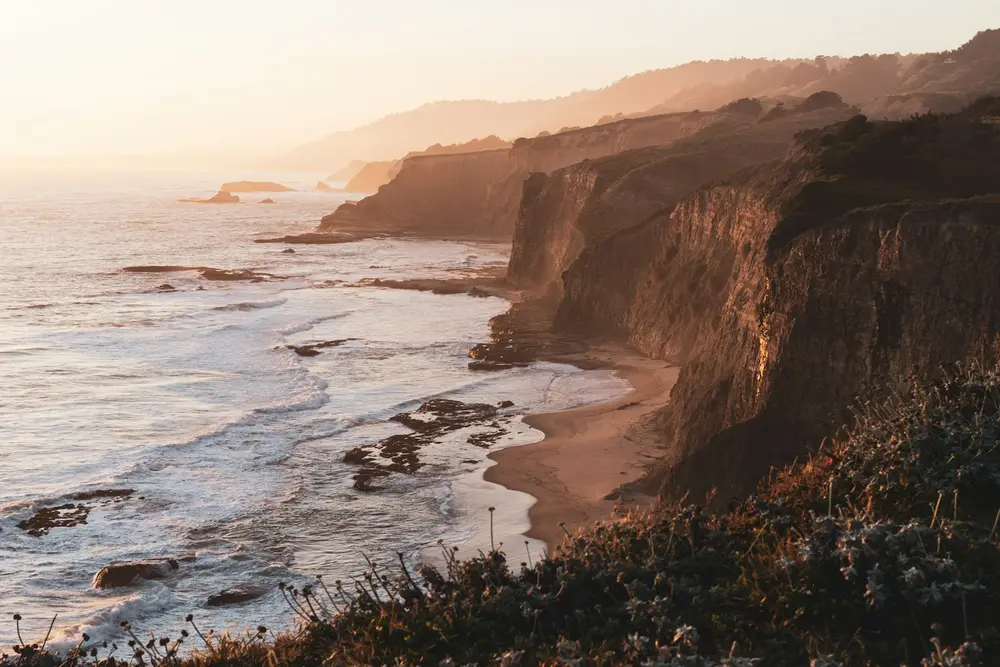
23 four-year colleges in California sit within 10 miles of an ocean beach. The closest is Pepperdine University, about 0.6 miles from Amarillo Beach. Every school below is ranked by how far you’d actually travel to get your feet in the water.
California’s beach colleges are spread across roughly 700 miles of coastline, from Humboldt in the redwoods down to San Diego. That range is the point: 13 of these campuses sit in the Warm band over the school year and 10 in the Hot band. No other beach state splits like that. Florida and Puerto Rico are hot end to end, New York is temperate end to end, and New England is cold. So the real question here isn’t whether you can go to college near the beach. It’s which coast you want. The 23 schools on this list run from 0.6 miles out to 9.1 miles, they include big public flagships and small private colleges, and the water at the north end behaves nothing like the water at the south end. Distances are measured from campus coordinates to the nearest named ocean beach. Enrollment and admissions figures come from the U.S. Department of Education.
How We Built This List
Four rules, all applied by a single database query. No school name and no distance on this page is typed in by hand.
A school qualifies if it’s in California, sits within 10 miles of an ocean beach, and is a four-year institution that primarily awards bachelor’s degrees or higher. That last rule is the site-wide scope, and it keeps out community colleges, vocational schools and single-subject institutions. Saltwater only, so lakefront campuses aren’t here. Ten miles is roughly the line between a beach you drive to on a long weekend and one you can reach after class.
The fourth rule is an enrollment floor of 750 undergraduates, and it exists because the first version of this ranking was useless. Sorted purely by distance, the top result was a graduate institute in Monterey with four students, 0.15 miles from the water, then two Antioch satellite campuses with 55 and 60. Every one of those is a real accredited institution. None is a school a high schooler is picking between.
Every California College Within 10 Miles of the Ocean
This is all 23 of them, closest first, not a top 10. If a California school is near the ocean and enrolls undergraduates at any real scale, it’s here.
1. Pepperdine University (Malibu)
0.6 miles to Amarillo Beach, 3,553 undergraduates. Acceptance rate 63%.
Hot school year, 63°F average September to May.
2. University of California-Santa Barbara (Santa Barbara)
0.6 miles to Isla Vista Beach, 23,113 undergraduates. Acceptance rate 33%.
Warm school year, 57°F average September to May.
3. University of California-San Diego (La Jolla)
0.9 miles to Torrey Pines City Beach, 34,948 undergraduates. Acceptance rate 27%.
Warm school year, 62°F average September to May.
4. Point Loma Nazarene University (San Diego)
0.9 miles to Bessemer Beach, 3,188 undergraduates. Acceptance rate 84%.
Hot school year, 62°F average September to May.
5. San Francisco State University (San Francisco)
1.7 miles to Phillip Burton Memorial Beach, 18,639 undergraduates. Acceptance rate 96%.
Warm school year, 55°F average September to May.
6. California State University-Long Beach (Long Beach)
1.7 miles to Mother's Beach, 35,924 undergraduates. Acceptance rate 46%.
Hot school year, 63°F average September to May.
7. University of San Francisco (San Francisco)
2.3 miles to Marshall's Beach, 5,287 undergraduates. Acceptance rate 62%.
Warm school year, 57°F average September to May.
8. Westmont College (Santa Barbara)
2.4 miles to Butterfly Beach, 1,302 undergraduates. Acceptance rate 77%.
Warm school year, 61°F average September to May.
9. University of San Diego (San Diego)
2.5 miles to Crown Point Shores, 5,671 undergraduates. Acceptance rate 52%.
Hot school year, 63°F average September to May.
10. University of California-Santa Cruz (Santa Cruz)
3.2 miles to Younger Beach, 17,940 undergraduates. Acceptance rate 66%.
Warm school year, 57°F average September to May.
11. Dominican University of California (San Rafael)
3.2 miles to San Quentin Beach, 1,114 undergraduates. Acceptance rate 84%.
Warm school year, 57°F average September to May.
12. California State University-Monterey Bay (Seaside)
3.3 miles to Marina State Beach, 6,819 undergraduates. Acceptance rate 97%.
Warm school year, 56°F average September to May.
13. Loyola Marymount University (Los Angeles)
3.8 miles to El Segundo Beach, 7,094 undergraduates. Acceptance rate 45%.
Warm school year, 62°F average September to May.
14. Vanguard University of Southern California (Costa Mesa)
4.1 miles to Newport Beach, 1,933 undergraduates. Acceptance rate 62%.
Hot school year, 63°F average September to May.
15. Mount Saint Mary's University (Los Angeles)
4.6 miles to Santa Monica Beach, 1,719 undergraduates. Acceptance rate 73%.
Hot school year, 63°F average September to May.
16. University of California-Los Angeles (Los Angeles)
5.3 miles to Palisades Beach, 33,475 undergraduates. Acceptance rate 9%.
Hot school year, 63°F average September to May.
17. University of California-Irvine (Irvine)
5.3 miles to Newport Beach, 30,197 undergraduates. Acceptance rate 29%.
Hot school year, 63°F average September to May.
18. California State University-Channel Islands (Camarillo)
5.5 miles to La Jolla Beach, 5,013 undergraduates. Acceptance rate 95%.
Warm school year, 61°F average September to May.
19. Concordia University-Irvine (Irvine)
6.9 miles to Newport Beach, 1,536 undergraduates. Acceptance rate 66%.
Hot school year, 63°F average September to May.
20. California State Polytechnic University-Humboldt (Arcata)
7.0 miles to Somoa Beach, 5,612 undergraduates. Acceptance rate 98%.
Warm school year, 51°F average September to May.
21. California State University-Dominguez Hills (Carson)
7.9 miles to Redondo Beach State Park, 12,538 undergraduates. Acceptance rate 93%.
Hot school year, 63°F average September to May.
22. San Diego State University (San Diego)
8.6 miles to Spanish Landing Beach, 35,377 undergraduates. Acceptance rate 36%.
Warm school year, 62°F average September to May.
23. California Polytechnic State University-San Luis Obispo (San Luis Obispo)
9.1 miles to Pirates Cove, 21,996 undergraduates. Acceptance rate 31%.
Warm school year, 59°F average September to May.
The Pacific Isn’t the Same Ocean Up and Down the State
Here’s the part most beach college lists skip. A campus 3 miles from the water in Arcata and a campus 3 miles from the water in San Diego are not offering you the same thing.
Northern California’s coast runs cold and often foggy straight through the summer. Surfers up there wear full wetsuits year-round, and a beach day usually means a jacket and a bonfire rather than swimming. It’s genuinely beautiful, and it is not Southern California. Head south and the water warms, the fog burns off earlier, and the beach turns into somewhere you swim without thinking about it. Neither is better. They’re different college experiences wearing the same word.
The air temperatures back that up. Across the school year, California State Polytechnic University-Humboldt averages 51°F while California State University-Dominguez Hills averages 63°F. Same state, same 10-mile radius from the same ocean, 12 degrees apart. Those are NOAA 1991 to 2020 normals for September through May, so they describe the months you’d actually be on campus rather than the summer everyone pictures.
For scale, compare that to the other big beach state. The coolest campus on our Florida beach colleges list averages 66°F over the school year, which is warmer than the warmest campus in California. Every Florida beach school runs hotter than every California one, with no overlap. Florida trades variety for certainty; California gives you a real choice and makes you make it.
So before you fall for a distance number, check what the coast actually does at that latitude. The school-year average sits on every card above and on every school profile, which is the quickest way to see what you’d be signing up for.
What a Distance Number Doesn’t Tell You
Miles here are straight-line distance from campus to the nearest named ocean beach, not drive time. In Los Angeles those two things come apart badly, and 4 miles can be 35 minutes at the wrong hour. Access varies too: some of these campuses look at the water, and some sit behind a freeway and a residential grid.
Cost is the other thing a distance number hides. Coastal California is expensive to live in, and that shows up in off-campus rent long before it shows up in tuition. If price is doing real work in your decision, cross-check the Budget Friendly collection and run each school’s net price calculator. If campus safety is the deciding factor, we’ve ranked the safest beach-town colleges nationally using federal Clery Act data.
Frequently Asked Questions
What’s the closest college to the beach in California?
Among four-year colleges with more than 750 undergraduates, it’s Pepperdine University at about 0.6 miles from Amarillo Beach. Drop the enrollment floor and a few very small graduate and satellite campuses sit closer, some under half a mile.
How many colleges in California are near the beach?
23 four-year colleges sit within 10 miles of an ocean beach once you exclude community colleges, online-first institutions and campuses under 750 undergraduates. Widen the radius or count two-year schools and the number climbs a long way.
Which California beach colleges are the biggest?
The large public campuses dominate on size, and several clear 30,000 undergraduates. Each entry above lists its enrollment. If you want the country’s beach schools ranked by size rather than by distance, that’s the Top Beach-Town Colleges list.
Can I go to school near the beach and near skiing in California?
Yes, and California is close to the only state where that works at any scale. We covered why California dominates the beach and ski combination and the Los Angeles schools that have both.
Are beach colleges harder to get into?
Location doesn’t set selectivity, though California’s coastal publics are in heavy demand for reasons that have little to do with the ocean. This list spans a wide range of acceptance rates. Each entry shows its rate, and the fuller picture is on the school profile.
Build Your Own California Beach Shortlist
This list is one cut of the data. If you want a different one, the California beach filter runs the same query you can steer yourself: change the beach radius, then stack tuition, campus safety score, enrollment size, Greek life or NCAA division on top and watch the map redraw. Every result links to a profile with climate normals, safety score, costs and the name of the beach you’d actually be driving to.
You can also browse all California colleges, put three of them side by side, or save the ones you like to a shortlist you can come back to. For the national picture instead of just California, the Beach Colleges collection holds the full filterable set.
College search for how you want to live. Start with the water and work backwards.